
Mifflin County Criminal Court Cases
Mifflin County criminal cases begin at the minor judiciary. A Magisterial District Judge handles the preliminary arraignment and bail, holds a preliminary hearing, and decides summary offenses. Felony and misdemeanor charges held for court then move to the Mifflin County Court of Common Pleas, Pennsylvania's 58th Judicial District. The two Common Pleas judges listed in current county materials are Aaron L. Gingrich and Jonathan W. Reed. That court handles the criminal information, formal arraignment, motions, pleas, trials, dispositions, and sentences that form the main court case file.
The Prothonotary/Clerk of Courts is custodian of the Common Pleas criminal docket. Its record includes filings, costs, restitution, sentencing, and bench-warrant hearing entries. Court Administration manages calendars and caseflow, but it is not a substitute for the clerk when a reader needs the filed record. A police narrative stays with the arresting agency, and Central Booking keeps intake data. Those distinctions stop a Mifflin County court search from drifting into the wrong office.
Mifflin County Courts by Level
A searcher should expect two dockets when a serious Mifflin County criminal case advances. The MDJ docket records the complaint, preliminary arraignment, bail action, and preliminary hearing. If the charge is held, a separate Common Pleas docket records the case after transfer. Summary cases may stay with the MDJ, so no Common Pleas result is expected. Traffic and nontraffic matters also remain in the minor courts unless an appeal creates a higher-court file. Pennsylvania's Crimes Code sentencing chapter supplies the statutory maxima tied to charge grades.
Search each court type separately in the Unified Judicial System portal. For a paper MDJ file, contact the exact district court named on that docket. Published county contacts include lines at 717-248-2607, 717-667-9626, and 717-248-8408, but judicial assignments can change. Confirm the current office and judge in the UJS court directory before a visit. The Common Pleas criminal desk is the right stop only after a Mifflin County case reaches that level.
Note: An MDJ docket and a Common Pleas docket can describe successive phases of one prosecution, not two separate arrests.
Searching Mifflin County Case Records
The free UJS Public Web Docket Sheets search supports a name or a record identifier. A full docket number is best. An OTN, or Offense Tracking Number, can link court activity to the same arrest cycle. A police incident or complaint number is useful when it appears on agency papers. Name searches need care because common names can return several people, and public date-of-birth display may be limited.
- Open Case Search and choose Courts of Common Pleas or Magisterial District Courts. Pick the level that fits the case stage.
- Select Mifflin as the county, then choose participant name, docket number, OTN, police incident or complaint number, or SID.
- Enter the known identifier. For a name search, add a first name, filing range, or birth date when the portal permits it.
- Open the matching docket. Check the court, filing date, charge rows, events, disposition, sentence, and listed hearing schedule.
- For a non-web document, plain copy, or certified copy, note the docket number and contact the clerk that holds the file.
These are the main Common Pleas fields documented for a Mifflin County criminal case search:
| Field Label | Type | Required | Notes |
|---|---|---|---|
| Search Type | Tabs or radio | Yes | Participant, docket, incident, OTN, or SID |
| Court Type | Dropdown | Yes | Choose Common Pleas for CP criminal cases |
| County | Dropdown | Yes | Select Mifflin from all Pennsylvania counties |
| Docket Number | Segmented fields | Conditional | Mifflin Common Pleas uses county code CP-44 |
| Participant Name | Text | Conditional | Last name, with first name as a refinement |
| Date of Birth | Date | No | Display and access can be restricted |
| Date Filed | Date range | No | Narrows a broad result set |
Read a Mifflin County Docket
A Common Pleas docket number follows the form CP-44-CR-sequence-year. “CP” marks the Court of Common Pleas, “44” is Mifflin County's code, and “CR” identifies the criminal division. The sequence and year complete the unique file reference. Give that full number to the clerk. It is much safer than asking staff to search a common surname with no date or court level.
PAeDocket, the official free mobile app, can search by case number, participant or organization name, OTN, police complaint or incident number, or SID. It offers convenient docket access, but it is not PATCH. PAeDocket displays judiciary case information. PATCH queries criminal-history information held by the Pennsylvania State Police Central Repository. A Mifflin County docket can show charge-level procedure that a background-check result does not, while PATCH may compile reportable history across Pennsylvania.
Inside a Mifflin County Case File
A public Mifflin County docket can show the caption, filing date, case status, judge, counsel, prosecuting agency, charge rows, bail, events, scheduled proceedings, disposition, sentence, and case financial information. The charge row deserves close reading. Charges in one case can end in different ways, so a case-level label cannot replace each charge's result. Docket entries may name a filed document without making the full pleading available for download.
| Case Number and Court | Identifies the court level, Mifflin code, sequence, year, and criminal division. |
|---|---|
| Charging Document | Shows the complaint or later criminal information and the statutes and grades alleged. |
| Docket Entries | Lists filings, orders, motions, counsel activity, and other dated court events. |
| Hearing Dates | Records scheduled proceedings, their type, location, and later status. |
| Disposition | States how each charge ended, such as guilty, dismissed, acquitted, or nolle prossed. |
| Sentence and Conditions | Shows the court's consequence, supervision, restitution, and related financial entries. |
The county Clerk of Courts page provides a useful view of the office responsible for that file.
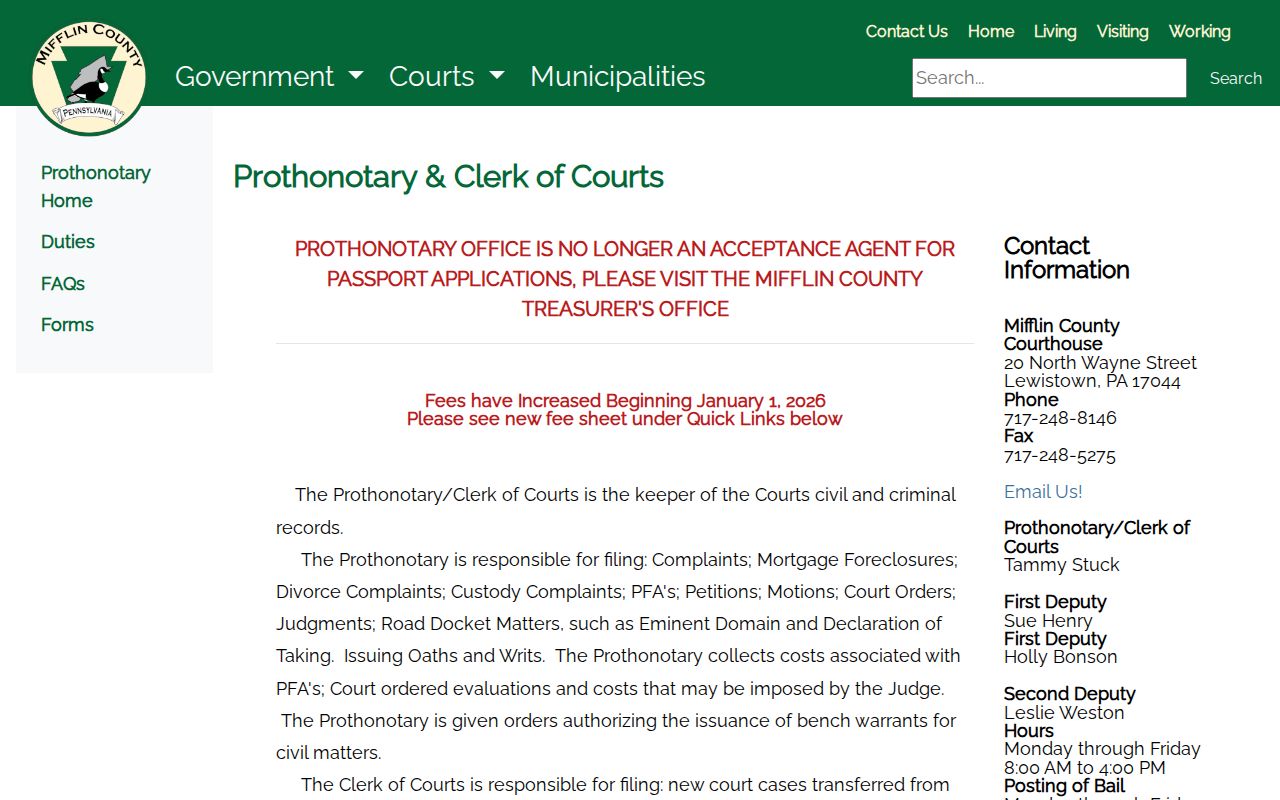
That clerk connection matters when the docket index is not enough and the underlying Mifflin County court document must be inspected or certified.
Mifflin County Clerk Copies
For a Common Pleas record that is not on the web, call the Clerk of Courts at 717-248-8146. The counter is in the Mifflin County Courthouse, 20 North Wayne Street, Lewistown, PA 17044. Court hours are 8:00 a.m. to noon and 12:45 p.m. to 4:00 p.m. Ask whether the needed paper can be inspected, copied, or certified, and give the complete CP-44-CR docket number. Confirm any per-page or certification charge before ordering.
The published 2026 Mifflin County clerk schedule lists $60 for a summary-conviction appeal, $91.25 for an appeal to a higher court, $65 for a bail-bondsman fee, and $190 for an expungement filing. Those amounts cover specific court transactions, not a general promise about copy costs. Paper MDJ files must be requested from the proper MDJ office. A searcher who starts at the right Mifflin County court level saves a trip between offices.
Note: Court Administration manages schedules and public information, while the Clerk of Courts maintains filed Common Pleas criminal records.
How a Criminal Case Moves
A Mifflin County prosecution normally starts with a complaint and preliminary arraignment before an MDJ. Bail is set or reviewed, and a preliminary hearing tests whether charges should move forward. A held charge transfers to Common Pleas, where the District Attorney files a criminal information. Formal arraignment follows. The docket may then record conferences, motions, a plea, or a trial. Each charge receives its own disposition. Sentencing comes after a guilty plea or finding, and later entries may cover post-sentence motions, appeal, costs, restitution, or supervision.
Case flow: Charges Filed → Arraignment → Pretrial → Plea or Trial → Disposition → Sentencing
Bail is not a case outcome. It is the set of terms used to secure a person's appearance while the case is pending. Likewise, “nolle prossed” means the prosecutor ended that charge with court approval, and dismissal is not a conviction. A guilty or nolo plea points to a conviction result. Reading dates and charge rows in order gives the most sound view of a Mifflin County criminal case.
Mifflin County Diversion Entries
Not every Mifflin County criminal case follows a straight trial-or-plea path. The Mifflin County District Attorney administers rehabilitative programs that include Accelerated Rehabilitative Disposition, County Intermediate Punishment, and Adult Treatment Court. ARD is a pretrial diversion route. County Intermediate Punishment gives the judges restrictive and restorative options for qualifying nonviolent people who would otherwise face confinement at the county facility. Adult Treatment Court can take diversionary or post-plea participants.
Program status and outcome must be read from the docket. An ARD entry does not mean the same thing as a guilty disposition. A post-plea treatment-court entry also differs from diversion before conviction. The charge-level result, program event, and final order together provide the useful answer.
The official Mifflin County program source shows how these alternatives fit the local court system.
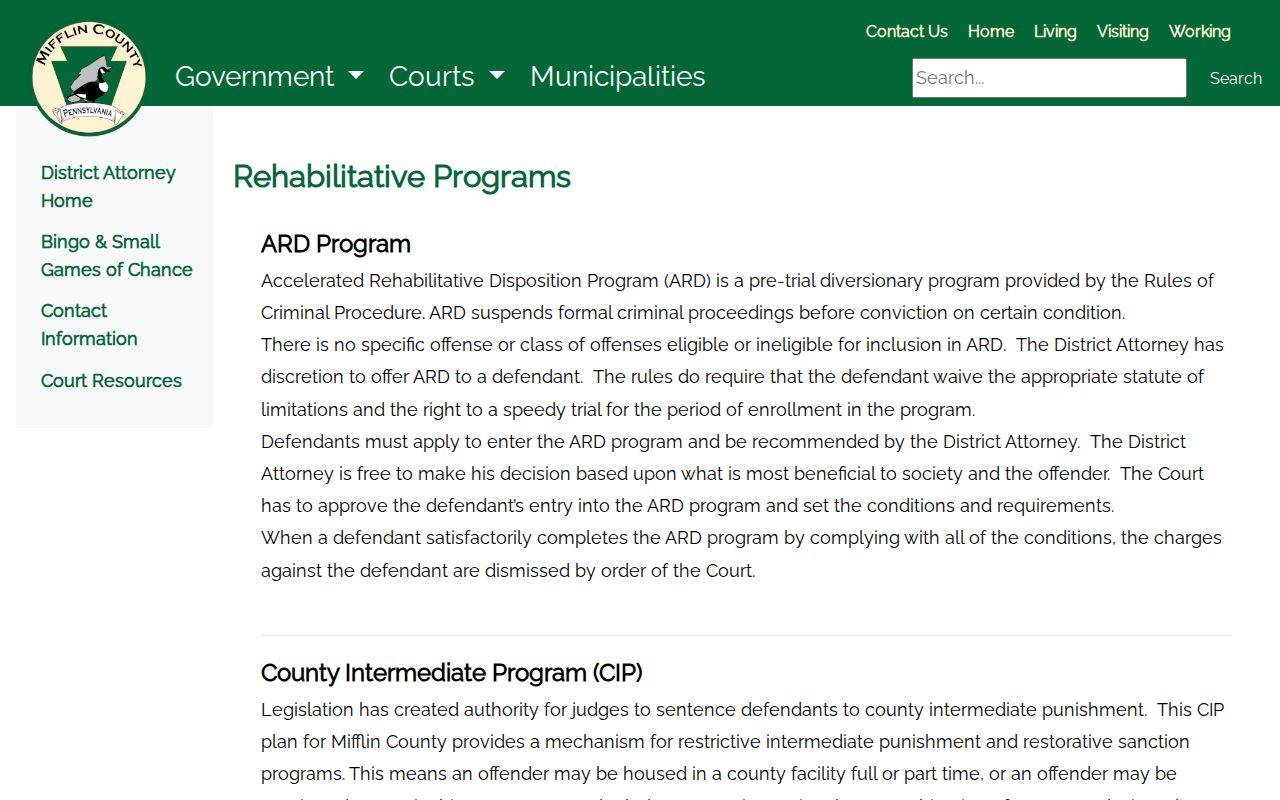
The image reinforces why a program entry should be read in its local procedural setting, not treated as a generic disposition code.
Case Record Access & Restrictions
Pennsylvania court records follow judiciary access policy, not the ordinary agency request path under the Right-to-Know Law. The UJS Case Records Public Access Policy permits public access while withholding protected identifiers, victim and informant details, juror data, protected information about minors, sealed matters, and limited-access cases. Social Security, driver-license, and financial-account numbers are excluded from the public view.
Remote access can be narrower than the court file. If a known Mifflin County docket does not appear, check the spelling and court level, then call the clerk. A missing web result may reflect a search error, filing lag, restricted remote access, sealing, limited access, or expungement under 18 Pa.C.S. § 9122. It does not prove that no proceeding ever existed. Protected information should not be sought from a second office to bypass the court's rule.
The Mifflin County Public Defender represents financially eligible people in qualifying proceedings. Its application instructions warn that an applicant with court within ten days should hand-deliver the sealed form. That confidential application is not a public court-record request.
Mifflin County Docket Limits
Online court access is broad, but it does not place every pleading on the screen. A docket entry can confirm that a motion or order was filed while leaving the full text at the clerk's counter. The Court Summary report can group Common Pleas criminal matters tied to the same participant, yet it is still a judiciary report. It should not be treated as a Pennsylvania State Police rap sheet.
The Pennsylvania courts' official case-access explanation points readers to free docket sheets and to the proper court for paper MDJ records.
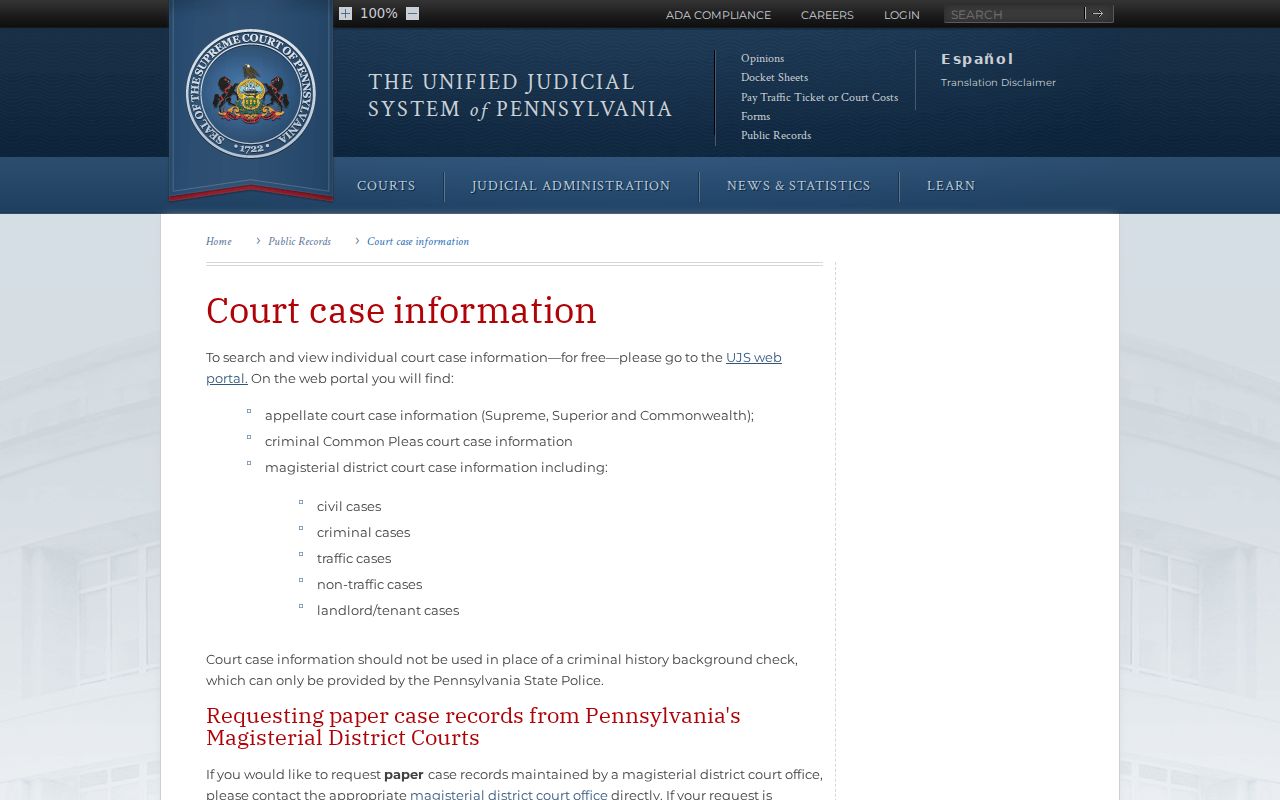
This distinction helps a reader use the portal as an index, then use the Mifflin County clerk as the source for a filed document when needed.