
Checking Criminal History in Mifflin County
Mifflin County criminal records do not sit in one database. Start by deciding whether the goal is a filed court case, current county custody, a police narrative, a Pennsylvania criminal-history result, or a registry entry. The free Unified Judicial System docket search is usually the best first look at charges and outcomes. The Pennsylvania State Police repository answers a different question. It compiles reportable state criminal-history information from fingerprint and disposition reporting.
Collect a full name, spelling variants, and any known date of birth, OTN, docket number, or police incident number. A common name can produce several possible cases. Match identifiers carefully, then read each charge through its final disposition. When an online record is incomplete, the proper fallback is the office that created or maintains that record.
- Search Mifflin County Common Pleas and Magisterial District dockets separately through the UJS portal.
- Check county custody through PA SAVIN or call Mifflin County Correctional Facility when status is urgent.
- Request an incident or arrest report from the arresting police agency, not automatically from the Sheriff.
- Use PATCH for an official Pennsylvania name-based check, or SP4-170 to review your own fuller state record.
- Ask the Clerk of Courts for a certified disposition when a portal entry must be confirmed or corrected.
Note: A docket search, custody search, and PATCH result answer different questions, so compare them without treating one as a substitute for another.
Mifflin County Records Have Three Homes
The local records trail is compact but divided. The Courthouse at 20 North Wayne Street holds the Court of Common Pleas, Clerk of Courts, Sheriff, Court Administration, and county probation. Mifflin County Correctional Facility at 103 West Market Street operates the jail and Central Booking. The arresting police department keeps the incident narrative. The Census Bureau's Mifflin County profile places this system in a county of more than 46,000 residents. A person may need all three stops because no office becomes custodian of every record after charges are filed.
The Mifflin County government site shows how county offices fit together.
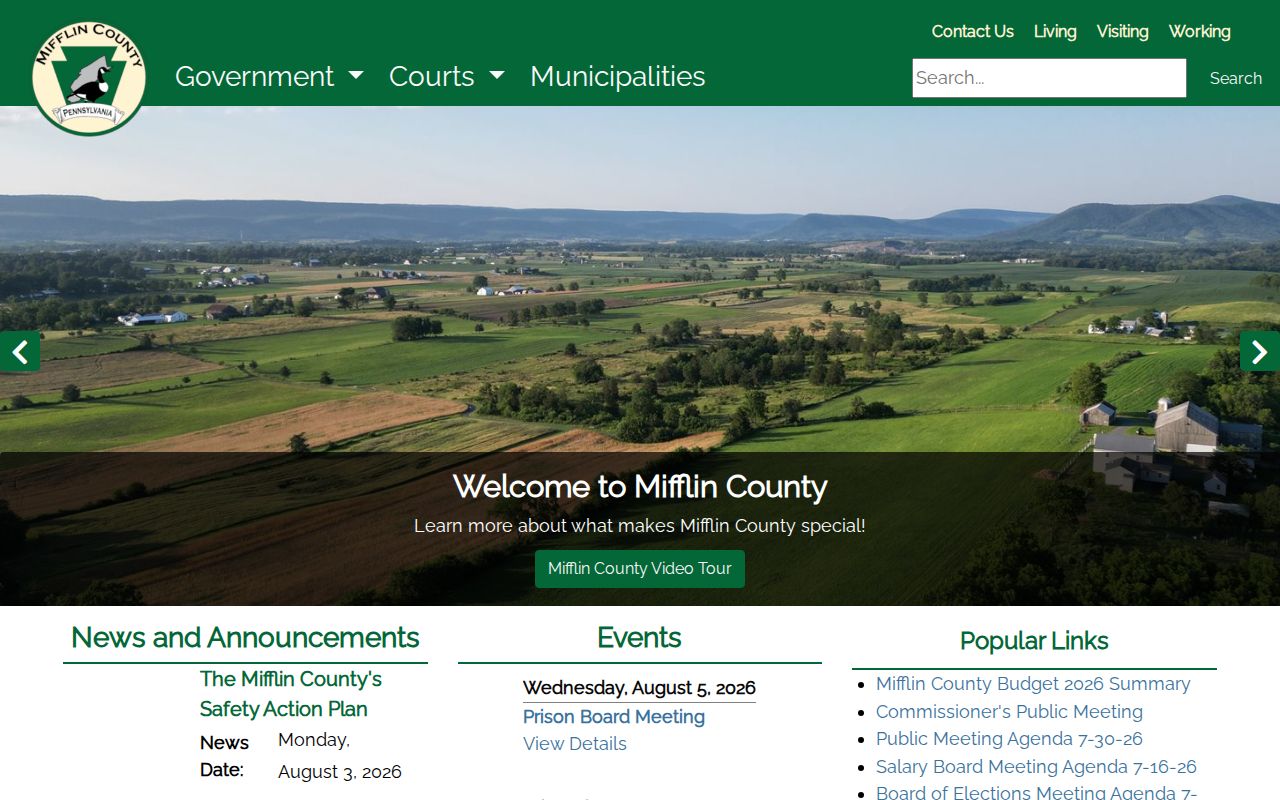
That department structure helps a searcher direct a narrow request to the right local custodian instead of sending a broad demand to the wrong office.
Clerk of Courts
20 N. Wayne St., Lewistown, PA 17044
717-248-8146
Criminal dockets, filings, dispositions, sentences, costs, and certified copies.
Correctional Facility
103 W. Market St., Lewistown, PA 17044
717-248-1130
Central Booking, county custody, public fingerprinting, and jail records.
Sheriff
20 N. Wayne St., Lewistown, PA 17044
717-242-1105
Common Pleas bench warrants, court security, transport, and court orders.
Pennsylvania Official Background Checks
The Pennsylvania State Police Bureau of Records and Identification runs Pennsylvania Access To Criminal History, known as PATCH. A standard online or mail name check costs $22. Online card payment is accepted, and a nonregistered user may place up to ten subjects in one session. A volunteer request is free on the proper mail form. Notarization, when available for the standard product, adds $5.
For review of your own Pennsylvania record, SP4-170 Access and Review is broader than the ordinary public result because it includes convictions and nonconvictions. It is mail-only and costs $20. Fingerprint-based programs use IdentoGO by IDEMIA with a purpose-specific service code. MCCF also identifies itself as a public fingerprint site, but callers should confirm its current method, hours, and price.
| Official channel | Scope | Published cost |
|---|---|---|
| PATCH standard check | Reportable Pennsylvania name-based CHRI | $22 |
| SP4-170 Access and Review | Your own Pennsylvania convictions and nonconvictions | $20 |
| PATCH notarization | Notarized standard response when available | $5 in addition |
| FBI Identity History Summary | Your own federal identity-history record | $18 direct FBI fee |
Mifflin County PATCH Record Review
A PATCH status of “Under Review” is not a criminal-record finding. It means the identifiers may match repository data and require manual work. Research for Mifflin County places that review window at two to four weeks. Save the control number and return to the status screen. An ordinary no-record response can arrive much faster, but its Pennsylvania-only scope still matters.
The official PATCH request entry provides the transaction route.
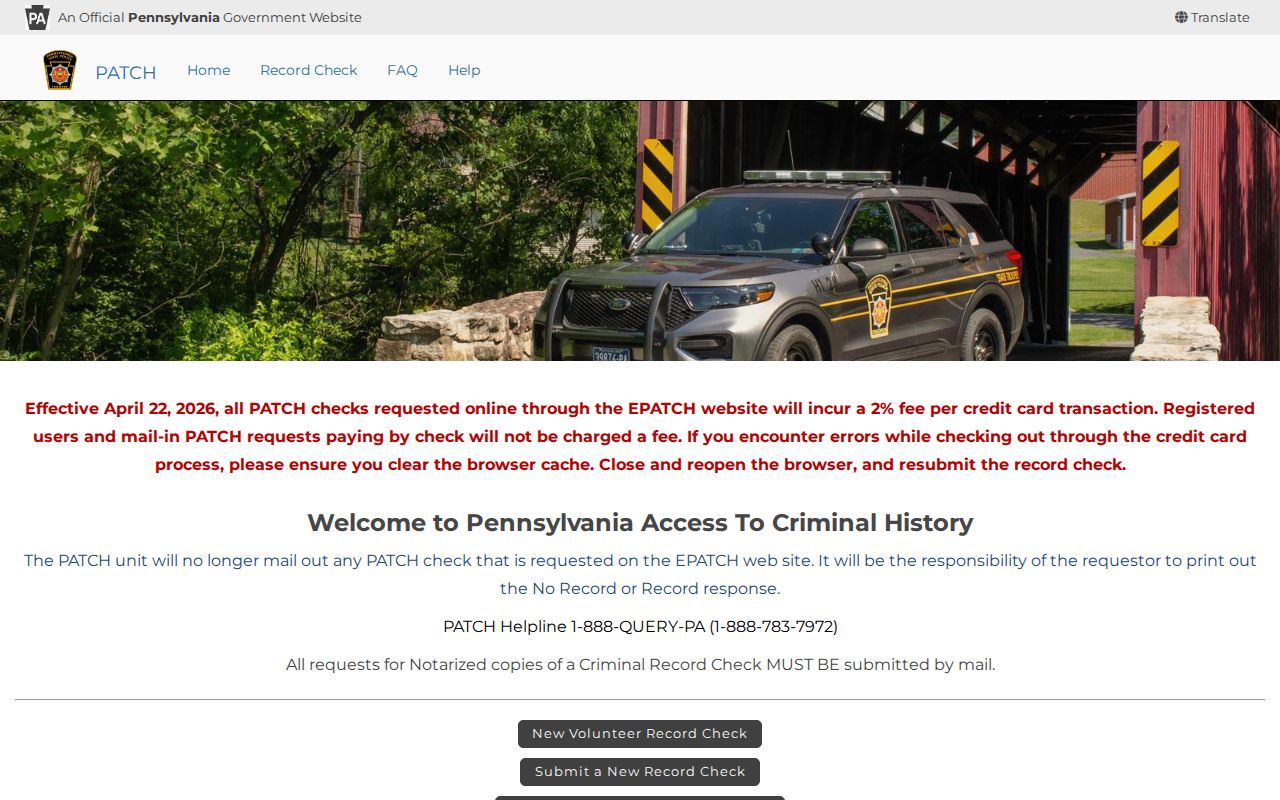
The request form gathers the subject's name and birth date, with optional identifiers such as aliases and Social Security number to help PSP distinguish people.
| PATCH field | Use | Requirement |
|---|---|---|
| Requester name and address | Identifies a nonregistered requester | Required |
| Subject first and last name | Primary name search | Required |
| Date of birth | Separates similar names | Required |
| Aliases, sex, and race | Adds matching detail | Supplemental |
| Control number | Retrieves later status | Save after submission |
Criminal Record Types
Each Mifflin County record captures a different stage. An officer creates the incident report. MCCF creates the booking file after intake. A Magisterial District Judge records the complaint, first appearance, bail, and preliminary events. The Clerk preserves the Common Pleas case if charges are held for court. PSP later compiles reportable arrest and disposition data in its repository.
Warrants and supervision add more layers. The Sheriff serves Common Pleas bench warrants, yet Mifflin County publishes no public active-warrant database. County probation keeps internal supervision files, while a public docket can show the sentence and revocation events. The Pennsylvania Department of Corrections locator covers state-sentenced people and DOC-supervised parolees, not MCCF custody.
- Police report: the arresting agency's incident account, subject to exemptions and redaction.
- Booking record: MCCF intake, fingerprints, photograph, charges, and custody transactions.
- Court docket: filed charges, bail, hearings, pleas, disposition, sentence, and financial events.
- PATCH record: reportable Pennsylvania criminal-history data held by PSP.
- Custody record: county status through PA SAVIN or state status through PA DOC.
Mifflin County Criminal Records Diverge
A booking, docket, and rap sheet can describe the same event but disagree at first. Booking preserves the allegations at intake. The MDJ and Common Pleas dockets show how prosecutors and judges handle each count. PATCH depends on fingerprint and disposition reporting. A count can be amended, dismissed, or resolved through ARD after MCCF already created the intake record.
The statewide UJS case search provides the court layer.
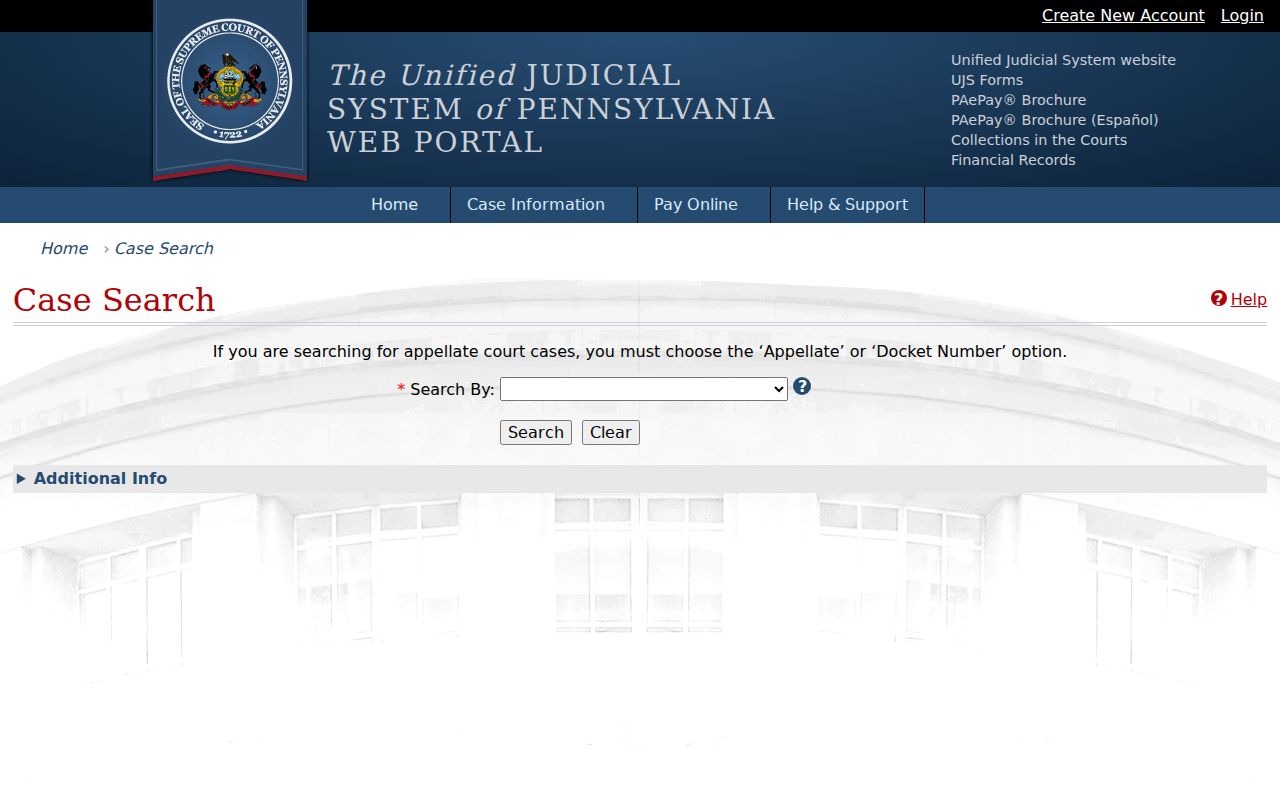
Search both Common Pleas and Magisterial District reports, because a matter may begin at the lower court and later receive a CP-44-CR docket.
- OTN
- The Offense Tracking Number that links arrest and court data.
- Disposition
- The way one charge ended, such as guilty, dismissed, acquitted, or nolle prosequi.
- ARD
- Pennsylvania's pretrial diversion program for eligible matters.
- Limited access
- A record restriction that hides qualifying information from ordinary public dissemination without destroying it.
Note: Bail shows release conditions while a case is pending; it never proves how a charge ended.
Inside a Mifflin County Criminal Record
A public Common Pleas docket often shows more procedure than a PATCH certificate. It can identify the CP-44-CR case, court, filing date, judge, OTN, prosecuting agency, counsel, charge grade, bail, scheduled proceedings, disposition, sentence, and financial data. A rap sheet instead organizes information around identity and arrest cycles. MCCF's public custody route is narrower and does not publish a detailed county roster.
| Name and identifiers | Legal name, aliases, birth information, and SID or FBI identifiers where law permits. |
|---|---|
| Arrest and booking data | Arrest date, agency, OTN, intake transaction, alleged statutes, and initial custody facts. |
| Charges and statutes | Separate counts with descriptions and grades such as F1, M2, or S. |
| Disposition | The outcome for each count, including dismissal, plea, verdict, or nolle prosequi. |
| Sentence | Confinement, probation, restitution, fines, and concurrent or consecutive terms. |
| Custody or supervision | County custody, DOC placement, probation, parole, or later revocation events. |
Mifflin County Booking Records Flow
MCCF is more than a detention site. It is Mifflin County's Central Booking Center for criminal fingerprinting and arraignment. Booking staff confirm identity, inventory property, photograph and fingerprint the arrested person, enter alleged charges, and arrange the preliminary arraignment. The arrest fingerprint transaction flows to the PSP Central Repository. Courts later report dispositions back to PSP.
The county courts page identifies the courthouse side of that path.
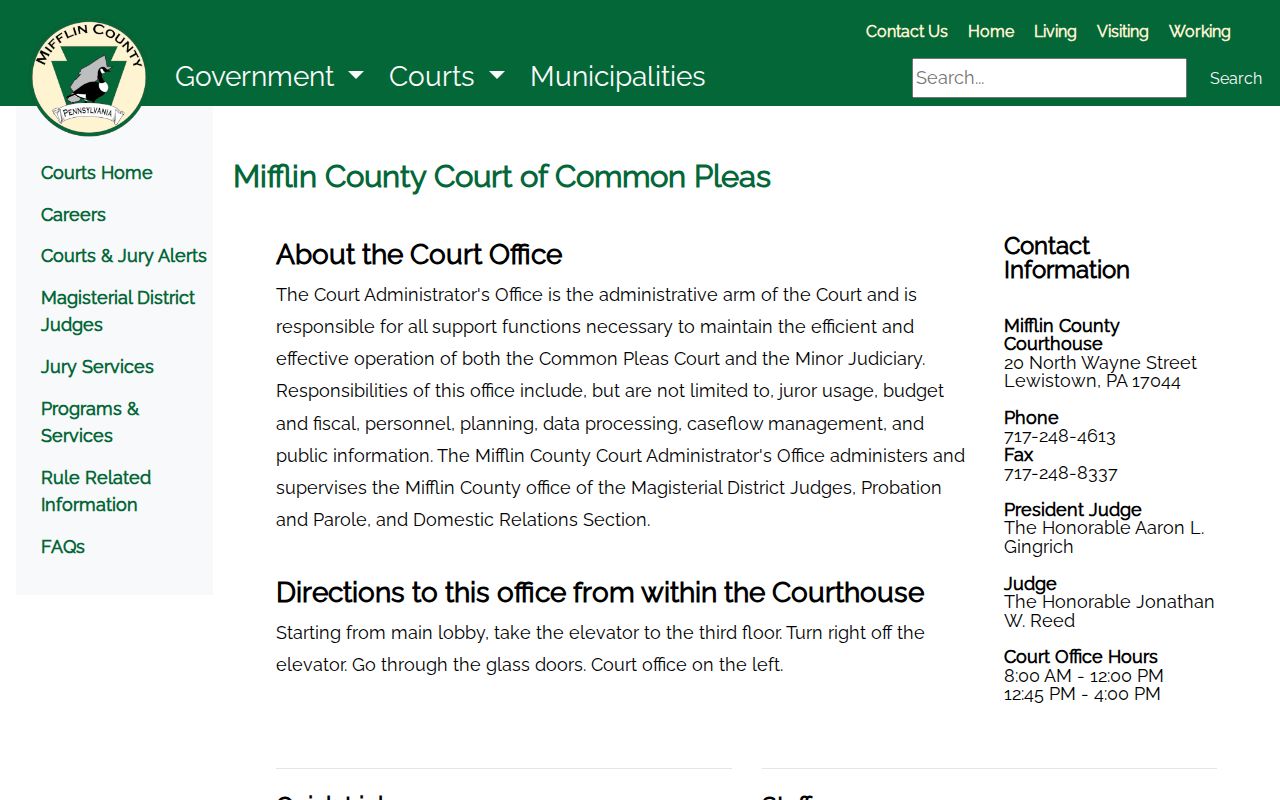
Once a complaint is filed, the Clerk and court portal become the sources for what happened to each charge, while MCCF remains the source for its own intake and custody data.
Local record flow: Arresting agency → MCCF Central Booking → Magisterial District Court → Mifflin County Common Pleas → PSP disposition update.
Public Access Laws in Pennsylvania
The Pennsylvania Right-to-Know Law presumes many agency records public, but its criminal-investigation exemption matters. A specific request can be emailed, mailed, faxed, or delivered to the agency open-records officer. Filing is free. An agency normally has five business days to respond, deny, or invoke more time. Court dockets follow judiciary access policy rather than the ordinary agency RTKL process.
Key Pennsylvania rules:
65 P.S. §§ 67.305 and 67.708(b)(16) presume access but exempt criminal investigative records.
18 Pa.C.S. Chapter 91 controls criminal-history dissemination, expungement, and limited access.
UJS Case Records Public Access Policy limits identifiers and remote access to protected case information.
42 Pa.C.S. Chapter 67A sets the separate Act 22 route for police audio and video.
A vague demand for “all records” can fail for lack of detail. Identify the event, date, location, people, record type, and preferred format. Police audio or video generally must be requested under Act 22 within 60 days, not through an ordinary RTKL filing.
Mifflin County Arrest Records Split
Jurisdiction is a practical search issue. Lewistown Police, Mifflin County Regional Police, Granville Township Police, Armagh Township Police, and Pennsylvania State Police each create their own reports. The Sheriff is not the default holder for municipal arrest narratives. Read the complaint or docket to identify the arresting agency before filing a request.
Lewistown Police records begin at 21 South Brown Street, Suite 1A. Regional Police uses 77 Reserve Lane. Granville Township Police is at 100 Helen Street, and Armagh Township Police is at 283 Broad Street in Milroy. PSP's locally published station contact is in Mifflintown. For the complete channel-by-channel process, use the county arrest lookup.
The Mifflin County Sheriff page describes the office's court-centered role.
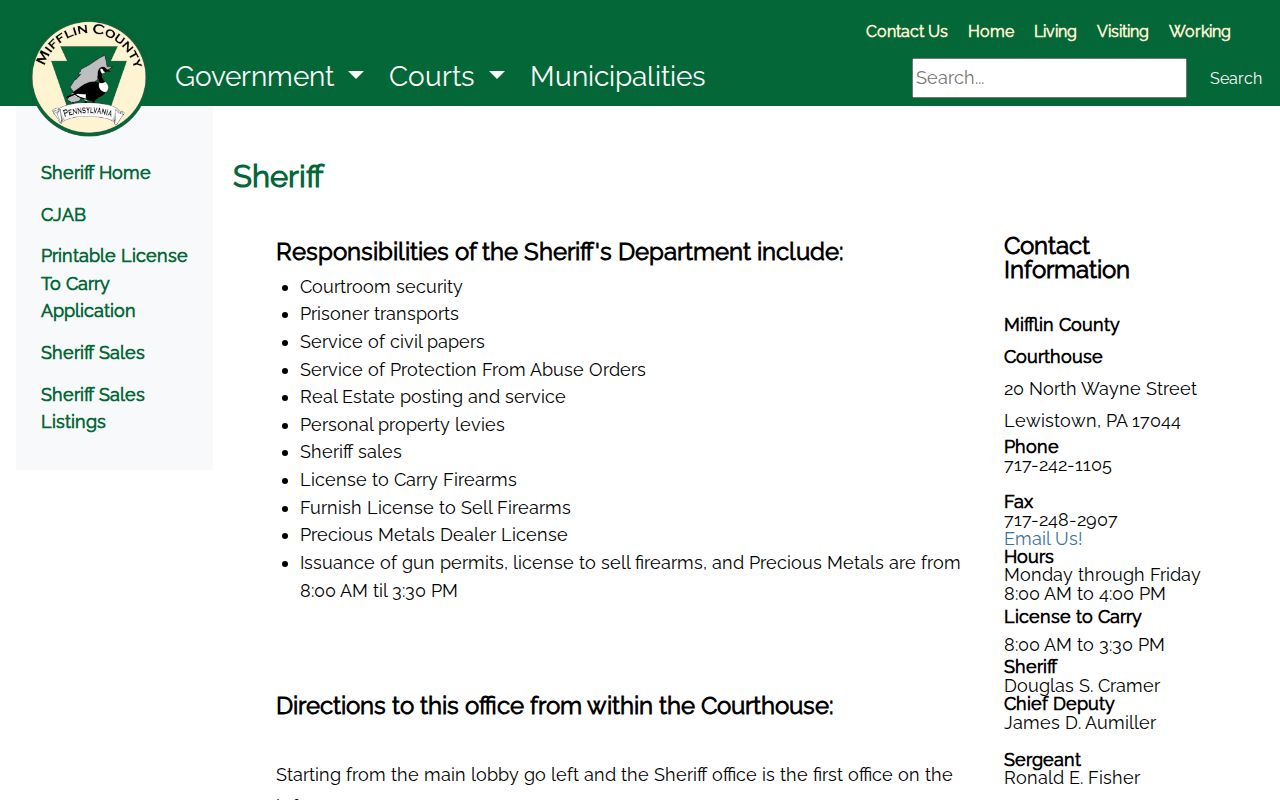
Its bench-warrant, transport, and court-security duties explain why the office may confirm a Common Pleas warrant but redirect a police-report request.
Sealed, Expunged, and Restricted Records
Pennsylvania separates expungement from limited access. Expungement can cover qualifying nonconviction information, pardoned matters, certain underage alcohol cases, some summary convictions after five arrest-free years, and narrow age-based cases. A conviction generally needs a pardon before expungement unless another statute authorizes relief. Juvenile records have their own standards.
Limited access hides qualifying information from ordinary public searches but preserves it for criminal-justice and other authorized purposes. Clean Slate can apply limited access automatically to qualifying cases. Eligibility depends on the charge grade, disqualifying offenses, time, and fulfillment of court obligations. Mifflin County's 2026 Clerk schedule lists a $190 expungement filing. File through the Clerk of Courts and verify the later result with UJS and your PSP Access and Review report.
Public silence proves only that the record is not visible in that search. Juvenile, sealed, limited-access, expunged, destroyed, and protected matters may all be absent. Never label a missing result as proof that a record was expunged.
Correcting Mifflin County Criminal Records
When PATCH lacks a disposition that appears on a Mifflin County docket, review your own state record through SP4-170. Compare the OTN, arrest date, charge, and case number. Then obtain a certified disposition from the Clerk at 717-248-8146 and follow the PSP challenge directions included with the report. A screen print may help diagnose the issue, but the certified court record carries more weight.
A missing result can also reflect spelling, the wrong court level, reporting delay, or lawful access limits. Search the MDJ and Common Pleas systems separately. PAeDocket offers the same sort of statewide court access on mobile, yet it is still not PATCH. If the issue concerns active county custody, use PA SAVIN and MCCF rather than waiting for a repository correction.
The Pennsylvania Inmate/Parolee Locator applies after a person enters state custody or DOC parole supervision.
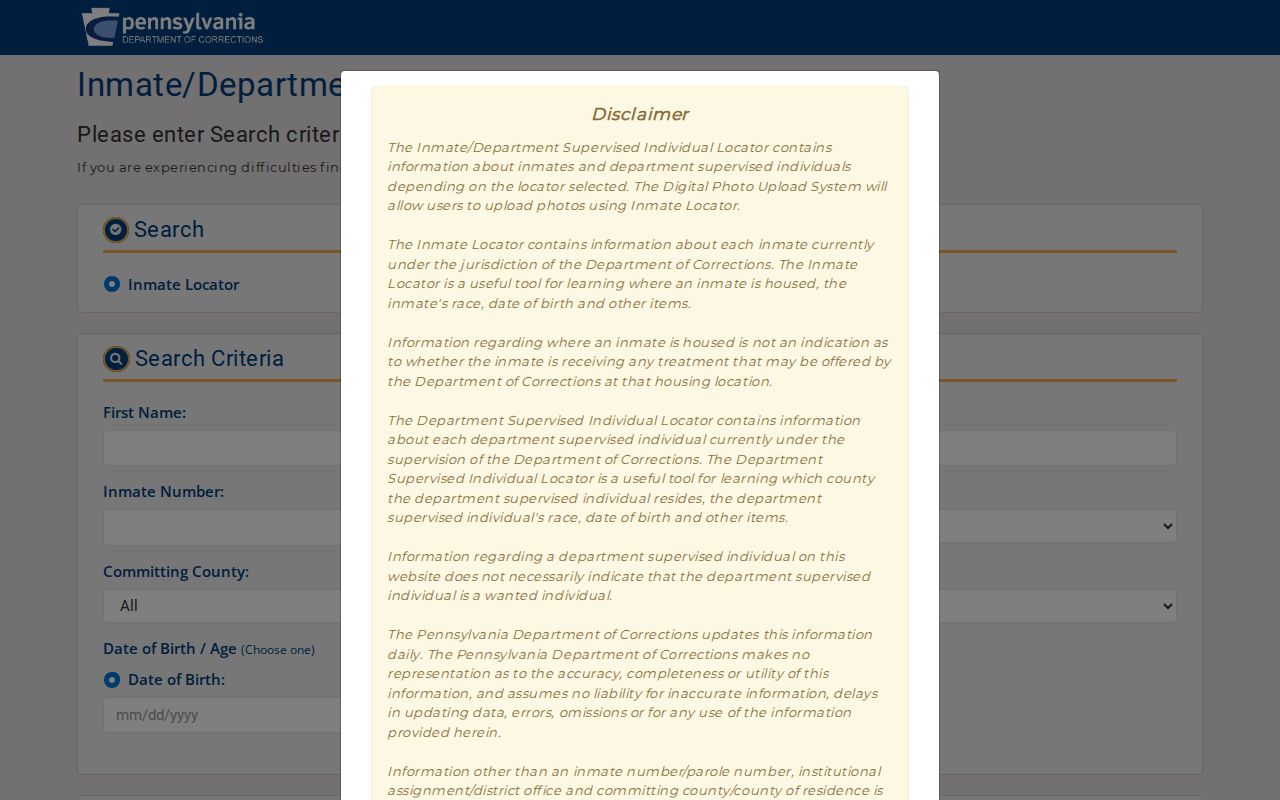
It updates daily and excludes people held only at MCCF, which is why a no-result answer there does not settle current county custody.
Mifflin County Criminal Records by City
Mifflin County has no incorporated city. The three largest named population centers require honest local labels: Lewistown and Burnham are boroughs, while Yeagertown is a census-designated place in Derry Township. Lewistown maintains its own police department. Burnham and the Yeagertown area route police records through Mifflin County Regional Police. None operates a municipal criminal court, so local complaints move through Pennsylvania's Magisterial District Courts.
Lewistown Criminal Records
County-seat borough with its own police records counter and nearby county court and booking offices.
Burnham Criminal Records
Incorporated borough served by Mifflin County Regional Police and the MDJ system.
Yeagertown Criminal Records
Derry Township CDP whose police reports route through Regional Police.
Mifflin County Federal Criminal Records
Federal records use a separate route. Mifflin County lies in the U.S. District Court for the Middle District of Pennsylvania, and federal criminal dockets are searched through PACER rather than Pennsylvania UJS. PACER requires an account and generally charges by the page, subject to its current fee rules. A federal docket does not replace a county docket or Pennsylvania criminal-history result.
An FBI Identity History Summary is a fingerprint-based, subject-only product. Federal custody is a third system: the Federal Bureau of Prisons locator searches people held in federal facilities and does not show MCCF or PA DOC custody. Mifflin County has no federal prison, so the court, identity-history, and custody channels should remain distinct.
Mifflin County Court Record Alternatives
Not every criminal docket ends with a standard conviction and jail sentence. Mifflin County's District Attorney describes ARD, County Intermediate Punishment, and Adult Treatment Court. ARD is pretrial diversion for qualifying matters. County Intermediate Punishment offers restrictive and restorative sanctions for eligible people who might otherwise face MCCF confinement. Adult Treatment Court can be diversionary or post-plea.
These routes make charge-level reading essential. A docket may show program admission, later completion, removal, plea, or a different final disposition. “ARD” should not be translated into “conviction” without reading the outcome. The same caution applies to nolle prosequi, which means the prosecutor ended a charge with court approval, and to a dismissal.
Mifflin County's Criminal Justice Advisory Board connects judges, the DA, Public Defender, probation, Warden, Sheriff, police chiefs, county officials, and service partners. That shared structure helps explain how treatment and supervision programs cross office lines while the underlying records remain with their lawful custodians.
A person reviewing a program entry should note its date, the charge tied to it, later court events, and the final disposition. Program participation alone does not show successful completion. Court financial entries may also continue after the main case event. For an older paper file or a certified copy, give the Clerk the CP-44-CR sequence and year. That precise identifier is far more useful than a broad request for a full criminal history.